A 20-Minute Beginner Workout You Can Do at Home
So, you want to get fit but don’t know where to start? Welcome to the club! Whether your goal is to lose weight, build strength, improve your stamina, or simply feel healthier, starting with a simple home workout can make the whole process much easier.
The good news is that you don’t need an expensive gym membership or fancy workout equipment to get started. All you need is a little space, comfortable clothing, and 20 minutes to move your body.
One of the biggest mistakes beginners make is trying to do too much too soon. They start with intense workouts, struggle to keep up, and eventually give up altogether. The secret is to start small, choose exercises that match your fitness level, and build consistency over time.
In this guide, you’ll discover a simple beginner workout you can do at home, how to perform each exercise correctly, and practical tips to help you stay motivated.
Why You Should Try a 20-Minute Home Workout
If you’ve been putting off exercise because you’re too busy or don’t want to go to the gym, a short home workout might be exactly what you need.
You don’t have to spend hours exercising to start building a healthier routine. A manageable workout can help you become more active while making it easier to fit exercise into your daily schedule.
Here are some reasons to give home workouts a try.
1. You Don’t Need a Gym Membership
One of the best things about exercising at home is that you can get started without paying for a gym membership.
Many beginner exercises use your body weight as resistance. Squats, modified push-ups, glute bridges, and planks can all be performed at home with little or no equipment.
This makes home workouts a convenient option if you’re working with a limited budget or prefer exercising in private.
2. You Can Exercise Even With a Busy Schedule
Finding time to exercise can be challenging when you have work, family responsibilities, and other commitments.
A short workout is easier to schedule than a long gym session. You can exercise before work, during a break, or in the evening when you have some free time.
The most important thing is finding a time that works for you and making it part of your routine.
3. It Helps You Build Strength and Endurance
Beginner-friendly bodyweight exercises can help you gradually improve muscular strength, coordination, and endurance.
Movements such as squats and lunges target your lower body, while push-ups and planks challenge your upper body and core.
As your fitness improves, you can increase the difficulty of your exercises or gradually perform more repetitions.
4. It Can Support Weight Management
If losing weight is one of your goals, regular exercise can be a useful part of your overall plan.
Physical activity helps you expend energy, and strength-building exercises help you develop and maintain muscle. Combining regular movement with balanced nutrition, adequate sleep, and sustainable habits can support long-term weight management.
Remember, no single workout guarantees weight loss. Focus on building a routine you can maintain rather than trying to achieve rapid results.
5. It Can Help Improve Your Mood
Exercise isn’t just about physical fitness. Regular physical activity may also help improve mood, reduce feelings of stress, and support overall well-being.
You don’t have to finish every workout feeling exhausted. Even a short session can be a positive step toward taking better care of yourself.
What You Need for a Beginner Home Workout
Before you get started, take a moment to prepare your workout space. A little preparation can make exercising more comfortable and help you move safely.
The good news is that you probably already have everything you need.
- Comfortable workout clothes: Choose clothing that allows you to move freely.
- Supportive athletic shoes: Wear shoes appropriate for the exercises and surface, particularly if you’ll be jumping.
- A non-slip exercise mat: This is optional but can make floor exercises more comfortable.
- A water bottle: Keep water nearby so you can drink when needed.
- Enough room to move: Clear the floor of furniture, loose rugs, and other obstacles.
You don’t need dumbbells or resistance bands for this routine. You can introduce additional equipment later if you want to make your workouts more challenging.
The Beginner Home Workout: Six Simple Exercises
Now that you’re ready, let’s get into the workout. This routine includes six simple exercises that work different muscle groups and can be modified to suit your fitness level.
The exercises are designed for beginners, but you should still work at a comfortable pace. If you’re new to exercise, begin with the easier variations and take extra rest whenever you need it.
1. Bodyweight Squats
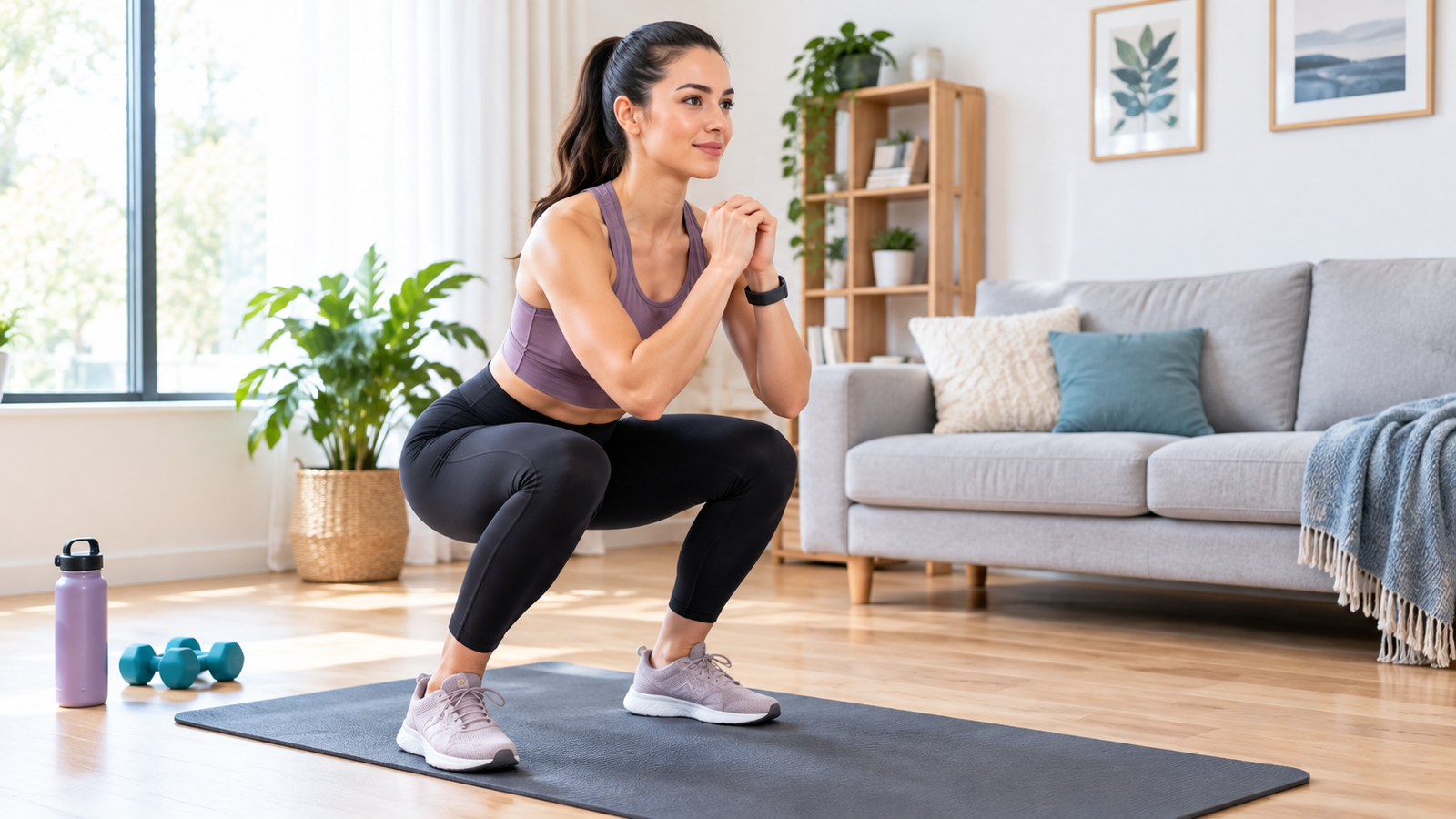
Bodyweight squats are an excellent starting point because they strengthen your legs and glutes while practicing a movement you use in everyday life.
You don’t need to squat very deeply to benefit. Focus on control, balance, and a comfortable range of motion.
How to do bodyweight squats:
- Stand with your feet approximately shoulder-width apart.
- Keep your chest comfortably lifted and your feet flat on the floor.
- Push your hips backward and bend your knees as if you’re sitting in a chair.
- Lower yourself only as far as you can comfortably manage.
- Press through your feet to return to standing.
Duration: 40 seconds.
Beginner tip: If balancing feels difficult, place a sturdy chair behind you and use it as a target. You can also hold a stable support for balance.
2. Push-Ups
Push-ups help strengthen your chest, shoulders, triceps, and core. Although traditional push-ups can be challenging at first, there are easier versions that allow you to build strength gradually.
How to do push-ups:
- Place your hands slightly wider than shoulder-width apart.
- Extend your legs behind you and keep your body aligned.
- Bend your elbows and lower your chest toward the floor.
- Push through your hands to return to the starting position.
- Repeat while maintaining control.
Duration: Up to 40 seconds.
Beginner tip: Start with wall push-ups. Stand facing a wall, place your hands against it, and bend your elbows to bring your chest closer to the wall before pushing away. As you get stronger, try push-ups against a sturdy counter or bench.
3. Walking Lunges
Walking lunges work your quadriceps, glutes, and other muscles involved in lower-body movement. They also challenge your balance and coordination.
If you’re a beginner, don’t worry about taking large steps. Smaller, controlled movements are a good place to start.
How to do walking lunges:
- Stand upright with your feet about hip-width apart.
- Step forward with one foot.
- Bend both knees as far as feels comfortable.
- Keep your torso steady and your front foot flat.
- Push through your front foot and bring your back foot forward.
- Alternate legs as you move.
Duration: 40 seconds.
Beginner tip: Try stationary lunges while holding a sturdy chair or wall for balance. If lunges cause discomfort, replace them with comfortable sit-to-stands from a chair.
4. Glute Bridges
Glute bridges are a beginner-friendly floor exercise that targets the gluteal muscles and engages the muscles around your hips.
They’re especially useful if you want to add a lower-body exercise without jumping or standing for the entire workout.
How to do glute bridges:
- Lie on your back with your knees bent.
- Place your feet flat on the floor, approximately hip-width apart.
- Rest your arms by your sides.
- Tighten your glutes and gently lift your hips.
- Pause briefly at the top without arching your lower back.
- Lower your hips slowly and repeat.
Duration: 40 seconds.
Beginner tip: Lift your hips only as high as feels comfortable. Focus on squeezing your glutes rather than pushing your back into an exaggerated arch.
5. Plank
The plank is a simple exercise for strengthening your core. Your core muscles help stabilize your body during exercise and many everyday activities.
You don’t need to hold a plank for several minutes to make it worthwhile. Start with a short hold while maintaining good form.
How to do a plank:
- Place your forearms on the floor with your elbows beneath your shoulders.
- Extend your legs behind you.
- Engage your abdominal muscles.
- Keep your body in a straight line without letting your hips sag.
- Breathe normally while holding the position.
Duration: Up to 40 seconds.
Beginner tip: Keep your knees on the floor to make the exercise easier. You can also perform a standing plank against a wall. Stop when you can no longer maintain a comfortable, controlled position.
6. Jumping Jacks
Jumping jacks add a cardiovascular element to your workout by raising your heart rate. They also involve coordinated movements of your arms and legs.
If jumping feels uncomfortable or you’re concerned about joint impact, the low-impact variation works well as an alternative.
How to do jumping jacks:
- Stand upright with your feet together and arms by your sides.
- Jump your feet apart while raising your arms overhead.
- Jump back to the starting position.
- Repeat at a pace you can comfortably maintain.
Duration: Up to 40 seconds.
Beginner tip: Instead of jumping, step one foot out to the side at a time while raising your arms. Alternate sides until the interval ends.
How to Structure Your Home Workout
Having a simple schedule makes it easier to follow the routine without constantly checking the clock. The right workout length depends on your fitness level, rest periods, and available time.
For the main circuit, perform each exercise for 40 seconds, followed by 20 seconds of rest. Complete one exercise at a time and move to the next when you’re ready.
| Workout stage | Suggested duration |
|---|---|
| Gentle warm-up | 3 minutes |
| Six exercises with short rests | 6 minutes per round |
| Two rounds | 12 minutes |
| Cool-down | 2–3 minutes |
Two rounds, combined with a three-minute warm-up and a short cool-down, make a manageable beginner session of approximately 17–18 minutes. You can use the remaining time to transition between exercises or take additional rest.
As your fitness improves, you can gradually work toward three rounds. Three complete rounds take approximately 18 minutes for the circuit alone, so the full session will exceed 20 minutes once you add a warm-up and cool-down.
Remember: The goal is not to rush. It’s to find a manageable starting point and gradually build your fitness.
Tips to Help You Stay Consistent With Home Workouts
Starting a workout routine is one thing; sticking with it is another. The good news is that you don’t need perfect motivation every day to make exercise a regular habit.
These practical tips can help you keep going.
1. Start Slowly and Build Gradually
It’s tempting to push yourself hard when you’re excited about a new fitness goal. However, doing too much too soon can leave you excessively sore and make it harder to exercise again.
Begin with a manageable number of repetitions and use easier exercise variations when necessary. As your strength and confidence improve, gradually increase your workload.
2. Create a Realistic Workout Schedule
You’re more likely to exercise consistently when you have a plan that fits your everyday life.
Choose a few days a week to begin with, leaving recovery time between more demanding sessions. You can add other forms of gentle activity, such as walking, on the days between workouts.
The best schedule is one you can realistically follow.
3. Focus on Proper Form
Performing an exercise correctly is more important than completing a large number of repetitions.
Move slowly enough to stay in control, breathe normally, and avoid forcing your body into uncomfortable positions. If an exercise feels too difficult, use an easier variation rather than sacrificing your technique.
4. Stay Hydrated
Keep water nearby and drink when you feel thirsty. Your hydration needs will depend on your activity level, the temperature, and how much you sweat.
If you’re exercising in a warm room, take breaks as needed and make sure your workout area is comfortable.
5. Track Your Progress
Tracking your workouts can help you notice improvements that might otherwise go unnoticed.
You could record the exercises you completed, the variations you used, or how challenging the session felt. Over time, you may notice that movements become easier or that you can maintain good form for longer.
Don’t compare your progress with someone else’s. Focus on your own starting point.
6. Listen to Your Body
Some muscle tiredness is normal when you’re beginning a new exercise routine, but sharp pain or unusual symptoms shouldn’t be ignored.
Stop exercising if you experience chest pain, dizziness, severe shortness of breath, or sudden pain. Seek appropriate medical attention when necessary.
If you have a chronic health condition, an injury, or concerns about starting exercise, consult a qualified healthcare professional for advice tailored to your circumstances.
Common Beginner Workout Mistakes to Avoid
Knowing what not to do can make your first few weeks of exercise more comfortable and sustainable. Keep these common mistakes in mind as you establish your routine.
- Doing too much too soon: Start with manageable sessions and increase the difficulty gradually.
- Skipping your warm-up: Spend a few minutes preparing your body before the main workout.
- Ignoring recovery: Rest days and adequate sleep help you recover between sessions.
- Comparing yourself with others: Everyone starts at a different fitness level.
- Expecting immediate results: Strength, endurance, and visible changes develop at different rates.
- Ignoring pain: Modify or stop movements that cause pain rather than forcing yourself to continue.
- Giving up after missing a workout: One missed session doesn’t undo your progress. Simply return to your routine when you’re ready.
Building a fitness habit takes time. A few manageable sessions each week are a better starting point than an ambitious plan you can’t maintain.
What to Do After Your Workout
Once you’ve finished exercising, spend a couple of minutes slowing down and allowing your breathing to return toward normal. Gentle walking and comfortable stretches can help you transition out of your workout.
You can stretch your calves, thighs, hips, chest, and shoulders if those movements feel comfortable. Avoid bouncing or forcing a stretch, and stop if you feel pain.
Afterward, drink water and eat your usual balanced meals. You don’t need special supplements or expensive recovery products to begin developing a healthier exercise routine.
Most importantly, give yourself credit for showing up. Every workout is an opportunity to practice a habit that supports your long-term well-being.
Conclusion
A beginner workout at home is a simple way to start moving more, build strength, and develop a consistent fitness routine without needing a gym membership or expensive equipment.
Begin with bodyweight squats, modified push-ups, lunges, glute bridges, planks, and jumping jacks. Adjust the movements to suit your fitness level, take breaks when needed, and gradually increase the challenge as you become stronger.
Remember, you don’t have to transform your lifestyle overnight. Start with a manageable session, choose a realistic schedule, and focus on making progress at your own pace.
Your first workout doesn’t have to be perfect. It just has to be a start.